• Please Create a Menu
Emergency Line (+555) 959-595-959
HealthFlex
×
  • Home
  • Our Hospitals
    • 7Med Hospital – Mau
    • 7Med Hospital – Moradabad
    • 7Med Hospital – Varanasi
  • Our Clinics
    • 7Med Academy Ballabgarh | Faridabad
    • 7Med Alwar – Solanki Hospital
    • 7Med Bahadurgarh – JJIMS
    • 7Med Bareilly – Keshlata Hospital
    • 7Med Bareilly – RMC Hospital
    • 7Med Bareilly – Sai Sukhda Hospital
    • 7Med Bikaner – Apex Hospitals
    • 7Med Faridabad – Dr. Suraj Prakash Aarogya Kendra
    • 7Med Gurugram – Vivekanand Arogya Kendra
    • 7Med Jaipur – Apex Hospital
    • 7Med Jaipur – CKS Hospital
    • 7Med Kashipur – Shree Krishna Hospital
    • 7Med New Delhi – Model Eye Hospital
    • 7Med New Delhi – Primus Hospital
    • 7Med Rewari – Katyal Hospital
    • 7Med Rishikesh – AIIMS
    • 7Med Rudrapur – The Medicity
    • 7Med Shahjahanpur – VAMC Rohilkhand Hospital
    • 7Med Trome Multi Speciality Hospital – Muzzaffarpur
  • Our Services
  • Knowledge Base
    • Kidneys & You
      • What are Kidneys ?
      • What do Kidneys Do ?
      • How does our kidney work?
      • What is Kidney Disease ?
      • Who are more prone to Kidney Disease ?
      • Treatment Options
        • Treatment Options
        • Kidney Transplant
      • BMI Calculator
    • Anaemia Management
      • Anaemia Symptoms
      • Fast Facts on Anaemia
      • Anaemia Monitoring
      • Anaemia Investigation
      • What is Erythropoietin?
    • Dialysis Adequacy
      • Dialysis Dose & Adequacy
      • Urea Reduction Ratio (URR)
      • KT/V
      • URR & KT/V
      • Improving KT/V
    • Vascular Access Management
      • Vascular Access & its Types
      • Taking Care of your Access
      • Taking care of your catheter
      • Catheters
    • Diet & Fluid Control Tips for Dialysis Patients
      • Make your low salt food Tasty!
      • Break the Salt Addiction
      • Avoid Artificial Salt Substitutes, Go Natural!
      • How to manage your daily fluid quota?
      • The Art of Savouring for Fluid Control
      • Few tips to control thirst & fluid intake
      • 5 Potassium Rich Fruits that CKD Patients Should Avoid
      • 5 Potassium Rich Vegetables that CKD Patients Should Avoid
    • Kidney Friendly Recipes
      • Kidney Friendly Recipe – Baingan Bharta
      • Kidney Friendly Recipe – Berry Tofu Smoothie
      • Kidney Friendly Recipe – Chana Dal Soup
      • Kidney Friendly Recipe – Masala Bhindi
      • Kidney Friendly Recipe – Mixed Veg Curry
      • Kidney Friendly Recipe – Oats Chila
      • Kidney Friendly Recipe – Omelet
      • Kidney Friendly Recipe – Rava Appam
      • Kidney Friendly Recipe – Sabudana Khichdi
      • Kidney Friendly Recipe – Vegetable Cutlet
    • Kidney Friendly Food
      • Kidney Friendly Food – Blueberries
      • Kidney Friendly Food – Green Vegetables
      • Kidney Friendly Food – Grapes
      • Kidney Friendly Food – Kidney Beans
      • Kidney Friendly Food – Lemon
      • Kidney Friendly Food – Strawberry
    • Health and Wellbeing
      • How to keep yourself and your kidneys healthy?
      • Take morning walks to stay healthy
      • Tips to increase your immunity
  • Careers
  • Blog
  • FAQ

Why Kidney Disease is Called a “Silent Killer” in India

6th January 2026Mayank SharmaBlogUncategorised
Why Kidney Disease is Called a “Silent Killer” in India

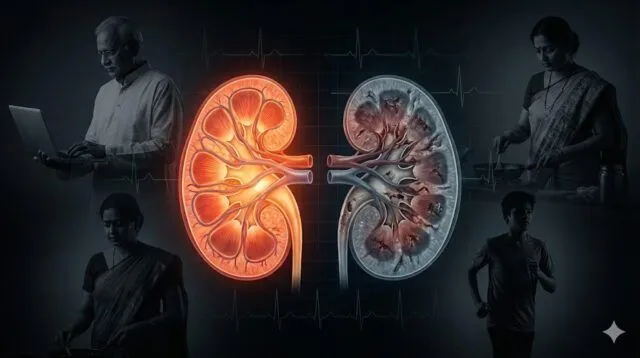
Last month, a 42-year-old IT professional walked into our clinic complaining of persistent fatigue. He thought it was work stress. His blood reports revealed something far more serious—his kidneys were functioning at just 25% capacity. He had advanced chronic kidney disease, and he had no idea.

This isn’t a rare story. Across India, millions are living with damaged kidneys without knowing it. That’s exactly why kidney disease has earned the frightening title of “silent killer.”

The Dangerous Silence of Kidney Disease

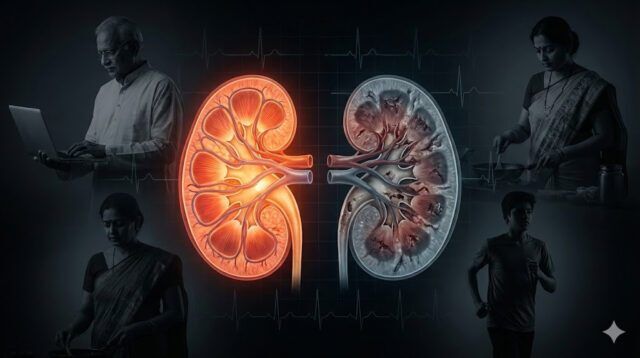
Your kidneys are remarkable organs. Even when they’re losing function, they continue working without raising an alarm. Unlike a heart attack that announces itself with chest pain, or diabetes that shows up with excessive thirst, kidney disease quietly progresses in the background.

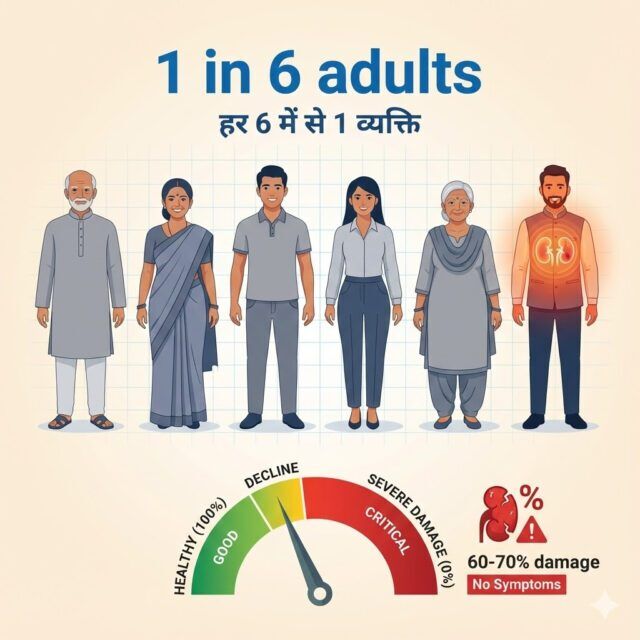
Here’s the troubling reality: Most people don’t experience noticeable symptoms until their kidneys have lost 60-70% of their function. By this stage, the damage is often irreversible, and patients need dialysis or transplant to survive.

In medical terms, we call this the “asymptomatic phase”—a period where your kidneys are deteriorating, but your body sends no warning signals. This silent progression is what makes kidney disease so dangerous.

The Alarming Numbers from India

The statistics paint a worrying picture. According to a comprehensive study published in The Lancet (2020), over 17% of India’s adult population shows signs of chronic kidney disease1. That’s roughly 1 in 6 adults. Yet, research from the Indian Journal of Nephrology indicates that less than 10% of these individuals are aware they have it.

In North India, particularly in states like Uttar Pradesh, Delhi, Punjab, and Haryana, the prevalence is even higher due to lifestyle factors, diabetes, and hypertension. According to data from the Indian Society of Nephrology, approximately 2.2 lakh new patients in India reach end-stage kidney disease requiring dialysis or transplant every year.

The tragedy? Many of these cases could have been prevented or slowed down with early detection and proper management.
chronic kidney disease awareness

Why Don’t People Notice?

Your kidneys have an extraordinary ability to compensate. When one part is damaged, the healthy portions work overtime to maintain your body’s balance. This compensation mechanism is both a blessing and a curse—it keeps you feeling normal while the disease silently advances.

Additionally, early kidney disease symptoms like mild fatigue, slight changes in urination frequency, or occasional swelling are easy to dismiss. We blame it on aging, stress, or poor sleep. We don’t think “kidney problem.”

The Indian Context Makes It Worse

Several factors unique to India amplify this silent crisis:

Late diagnosis culture: Many Indians avoid routine health check-ups, preferring to visit doctors only when symptoms become unbearable. By then, kidney disease has often progressed significantly.

Diabetes and hypertension epidemic: India has over 77 million diabetics and a similar number of people with uncontrolled blood pressure—both are leading causes of kidney disease. Many don’t manage these conditions properly, allowing kidney damage to occur unnoticed.

Lack of awareness: Unlike heart disease or cancer, kidney disease doesn’t receive the same public health attention. Most people don’t know what kidney disease symptoms look like or who is at risk.

Financial barriers: Even when people suspect something is wrong, the fear of medical expenses prevents them from getting tested. Ironically, early detection and treatment cost a fraction of what dialysis or transplant eventually requires.

Breaking the Silence: What You Can Do

The good news? Kidney disease is highly detectable with simple blood and urine tests. A basic kidney function test measuring creatinine, eGFR (estimated Glomerular Filtration Rate), and urine albumin can reveal problems years before symptoms appear.

You should get tested if you:

  • Are over 40 years old
  • Have diabetes or high blood pressure
  • Have a family history of kidney disease
  • Are you overweight or obese
  • Have heart disease
  • Smoke or use tobacco products
  • Take painkillers regularly

Early detection means early intervention. With proper medication, dietary changes, and lifestyle modifications, we can slow or even halt the progression of kidney disease. But this only works if you catch it before silence turns into crisis.

Your Kidneys Deserve Attention

Don’t wait for symptoms to appear. By the time kidney disease announces itself with clear signs, you may have already lost most of your kidney function. Annual health check-ups aren’t luxuries—they’re necessities, especially if you’re in a risk category.

Your kidneys filter your entire blood volume dozens of times daily, removing waste, balancing fluids, and regulating vital functions. They deserve the same preventive care you give your heart or your blood sugar.
Why Kidney Disease is Called a Silent Killer in India

Share Your Story With Us

Have you or a loved one experienced kidney disease? We’d love to hear your journey—the early signs you noticed, challenges you faced, or how early detection helped you. Your story could save someone’s kidneys and potentially their life.

Connect with us through Kidney Support Network. We’re building a community of kidney health warriors, and your experience matters. Selected stories may be featured in our Hindi podcast or educational workshops, helping thousands across North India learn from real experiences.

Take Action Today

If you haven’t had a kidney function test in the past year and you’re over 40 or have risk factors, schedule one this week. A simple blood test could be the difference between healthy kidneys and a lifetime of dialysis.

At 7Med India, our 19 dialysis centers across North India see hundreds of patients every week—many wish they had known about their kidney disease earlier. At Epitome Kidney Urology Institute, our nephrology team specializes in early detection and intervention programs.

Don’t let kidney disease remain silent in your body. Make some noise—get tested, stay informed, and protect your kidneys before it’s too late.

REFERENCES

  • The Lancet Global Health (2020). “The Global Burden of Chronic Kidney Disease” – https://www.thelancet.com/journals/langlo/article/PIIS2214-109X(20)30003-3/fulltext
  • Agarwal SK, Srivastava RK. “Chronic Kidney Disease in India: Challenges and Solutions.” Indian Journal of Nephrology. 2018;28(4):247-249. – https://www.indianjournalofnephrology.org
  • Indian Society of Nephrology. “CKDRI – Chronic Kidney Disease Registry of India.” 2020 Annual Report. – https://www.indiansocietyofnephrology.org
  • International Diabetes Federation. “IDF Diabetes Atlas – India.” 2021. – https://diabetesatlas.org

Source: “Why Kidney Disease Is Called a Silent Killer in India” originally published on Epitome Hospitals website on 22 December 2025 — the original article can be read at: https://www.epitomehospitals.com/blog/why-kidney-disease-is-called-a-silent-killer-in-india/
Read More

How to Choose the Right Dialysis Centre in Delhi NCR (And Avoid Costly Mistakes)

10th December 2025Mayank SharmaBlogdialysis center in delhiDialysis centre
How to Choose the Right Dialysis Centre in Delhi NCR (And Avoid Costly Mistakes)

Last month, a 52-year-old patient walked into the Dialysis Centre at Epitome Kidney Urology Institute with a severe infection. He’d been on dialysis for eight months at a dialysis centre in Delhi. Upon examination, our medical team found that his dialysis access site was inflamed, he had recurring fevers, and his recent blood reports showed alarming signs of infection.

“Hame laga dialysis to dialysis hi hai kisi bhi clinic mein karao, Pani hi to nikalwana hota hai,” he told our Nephrologist, his voice tired and defeated. “Hamare ghar ke sabse paas jo hospital tha wahi dialysis kara rahe the.”

(I thought dialysis is just a simple procedure to get extra fluid/water removed. There is a dialysis facility in a hospital near our home, so we were getting dialysis there itself.)

That decision almost cost him his life.

After nearly one and a half decades of running dialysis clinics across North India through 7Med India and now providing full-fledged kidney care, including Kidney Transplant at Epitome Hospital, I’ve seen this story play out too many times. Patients assume dialysis is just a simple process of removing fluid/urine, which is not the whole truth. They assume that every center follows the same protocols, uses the same quality standards, and delivers the same outcomes.

They’re dangerously wrong.

The dialysis center you choose isn’t just about convenience or cost. It’s literally a matter of life and death. Patients can face numerous issues like infections and toxicity in the bloodstream due to poor water quality, sero-conversion and other life-threatening infections due to poor sterility and hand hygiene. Lack of attentive staff and inadequate monitoring can lead to missed warning signs which, at times, can be fatal.

And the quality gap between a dialysis clinic near your home and the best in the city can be wider than ever.

The Hidden Dangers of the Wrong Choice

After kidney failure, dialysis becomes your lifeline—filtering waste and excess fluid from your blood two to three times a week, every week, potentially for the rest of your life. But what most patients don’t realize is that the quality of that filtration depends mostly on factors they can’t see.

Let’s See What You Must Look For (Before It’s Too Late)

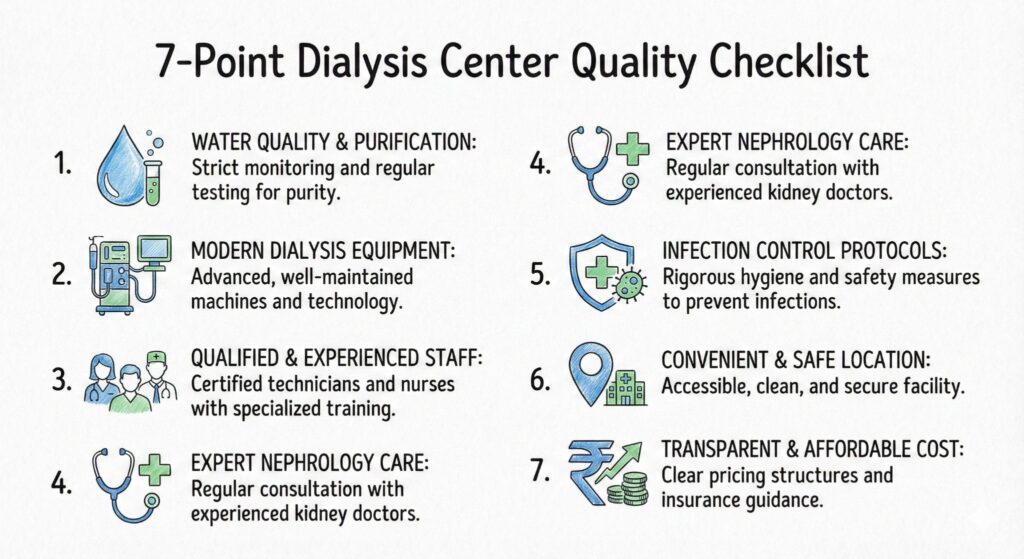
Choosing a dialysis center isn’t like picking a restaurant. You can’t rely just on Google reviews alone. Below are the non-negotiables I recommend every patient should look for while choosing a dialysis clinic:

1. Water Testing Reports

Ask for recent water testing reports. Any quality-focused centre should test water quality regularly and comply with AAMI (American Standard For Dialysis Water) or EU (European Standard For Dialysis Water) standards, or our own Indian standards recommended by ISN (Indian Society of Nephrology). If the dialysis staff hesitates to show you these reports or avoids sharing them, consider it a big red flag.

The water quality defines everything else. Don’t compromise on it.

2. Dialyzer Reuse Protocols

Find out if the center reuses dialyzers and, if so, what protocols they follow. Specifically ask:

  • Do they have an automated dialyzer reprocessing machine?
  • How many times is each dialyzer typically reused?
  • How do they determine when a dialyzer should no longer be used?

Without automated reprocessing, there’s no reliable quality control. Manual cleaning and testing leave too much room for human error.

3. Staffing and Staff Training

The dialysis technician-to-patient ratio matters tremendously. International standards recommend one trained dialysis nurse for every four to five patients. Ask about staff credentials—are they trained dialysis technicians or general nursing staff?

A well-trained, adequately staffed center can identify and address complications before they become emergencies.

4. Nephrologist Presence and Accessibility

In India, it’s practically not possible to have a Nephrologist at every dialysis center, thus if the dialysis clinic is covered by a doctor and supervised by a Nephrologist, that should be fine. The target for a patient should be to do regular consultations with the treating Nephrologist, and the dialysis clinic should also be regularly visited by a Nephrologist to do an overall review of clinical protocols.

On this front, single-specialty dialysis chains like 7Med and hospitals focused on kidney care like Epitome Kidney Urology Institute do much better comparatively.

At our 7Med clinics and at Epitome, we ensure nephrologist oversight because we’ve learned—often the hard way—that minutes matter in dialysis emergencies.

5. Quality & Infection Control Protocols

Ask about their infection control measures. How often are machines disinfected (after each dialysis or once a day)? What protocols do they follow for vascular access care? Do they segregate patients with infections? What’s their track record with dialysis-related infections?

These aren’t invasive questions—they’re your right as a patient whose life depends on these answers.

A good indicator of quality in today’s environment are accreditations. Accreditations from NABH, QCI, etc., guarantee that the dialysis clinic follows industry-standard quality protocols which are audited regularly by a third party independently.

6. Location and Consistency

While quality trumps convenience, you also need to think practically. You’ll be coming to this center three times a week, potentially for years. Is it accessible? Can you maintain that schedule during the monsoons, Delhi’s infamous traffic jams, or when your own health fluctuates?

More importantly, can the center accommodate you consistently? Nothing disrupts care more than constantly shifting between centers because your “home” facility can’t guarantee you a slot.

7. Insurance Panels

Dialysis is a costly affair. Dialysis patients end up paying close to 20-30 thousand rupees just for dialysis. Add in the medication costs, diagnostic tests, and doctor consultation costs, which can take this amount anywhere up to 40 to 50 thousand rupees. Thus, identifying a dialysis clinic which is empanelled with the insurance company you are insured with will help you significantly.

In case you don’t find a hospital or dialysis clinic empanelled with your insurer, you don’t need to get discouraged or compromise on your choice of dialysis clinic. Talk to the dialysis provider, and they will help you understand and navigate the reimbursement process.

People meeting certain criteria may be covered under PMJAY (Pradhan Mantri Jan Arogya Yojana) or Ayushman Bharat Yojana—check your eligibility with the hospital.

The Delhi NCR Dialysis Landscape

Delhi NCR has seen explosive growth in dialysis centers over the past decade. Government initiatives like Ayushman Bharat and the National Dialysis Program have made treatment more accessible—which is wonderful. But accessibility means nothing without quality.

The challenge for patients is that not all centers are created on quality parameters. Some are run by experienced nephrologists with decades of kidney care expertise. Others are commercial ventures where dialysis is just another revenue stream, managed by administrators who’ve never actually cared for a kidney failure patient.

I strongly recommend patients to stay away from dialysis clinics which are operated by a dialysis technician and not a proper hospital or organizations dedicated to providing dialysis like 7Med India.

At 7Med India, we’ve built our network of 20 dialysis clinics across 14 cities with one non-negotiable principle: PATIENT FIRST. Not just that, we have taken our commitment to kidney patients to the next level by establishing institutes like Epitome Kidney Urology Institute which provide holistic kidney care including kidney transplants, not just dialysis. Not to forget that our clinical programs are governed by preeminent Nephrologists like Dr. Vijay Kher, Chairman of Epitome Kidney Urology Institute, and Dr. Ajay Kher, Group Medical Director.

We don’t just provide dialysis—we help our patients understand their condition, participate in their care decisions, and recognize warning signs that need attention.

This isn’t a sales pitch. It’s a reflection of what I’ve learned after spending years watching patients suffer from fragmented, poor-quality care.

Listen to our detailed podcast episode: “Things To Consider While Choosing A Dialysis Clinic” at Kidney Support Network Podcast.

This episode breaks down each critical factor in Hindi, in simple language that patients and families can understand and act on. Because in kidney care, knowledge isn’t just power—it’s survival.

Don’t let convenience or cost alone drive this decision. Don’t assume all centers are the same. And don’t wait until complications force you to learn these lessons the hard way.

Your kidneys have failed. But your dialysis center can still become part of your winning team.

Need Help Choosing the Right Dialysis Center?

Don’t navigate this decision alone. Contact us for expert guidance and consultation.

7Med India – Dialysis Centers Across North India
📞 +91 7718-771-888
✉️ info@7medindia.com
🌐 www.7medindia.com/our-clinics

About the Author: Mayank Sharma is CEO and Co-Founder of Epitome Kidney Urology Institute and Co-Founder & Director of 7Med India. With over 18 years in healthcare, he’s dedicated to patient education and improving dialysis care standards across India.

Related Reading:

  • Understanding Dialysis Adequacy – KT/V Explained
  • Vascular Access Care Guide
  • Diet Tips for Dialysis Patients

Source: https://www.kidneysupportnetwork.com/blog/how-to-choose-the-right-dialysis-centre-in-delhi-ncr-and-avoid-costly-mistakes/

Read More

7MED Welcomes Strategic Investment from PVP Ventures to Accelerate Healthcare Innovation

8th September 2025Prem MalhotraBlogNews & Updates

Strengthening Our Mission to Deliver Quality Renal and Urology Care Across India

A New Chapter fo7MED

We are proud to announce that PVP Ventures Limited, a forward-looking investment company, has acquired a 41.23% strategic stake in 7Med India Pvt. Ltd. and Epitome Group of Hospitals. This investment marks a significant milestone in our journey and further empowers our commitment to accessible, high-quality, and technology-driven healthcare.

The transaction, announced on August 29, 2025, lays the foundation for long-term collaboration, with plans to grow the partnership.


Who We Are: The 7MED Impact

Founded with the mission of transforming renal care in India, 7MED and Epitome Hospitals operate a network of:

  • 22 dialysis centers (both standalone and within hospitals)
  • 4 super-specialty hospitals
  • Coverage across six Indian states, focused on nephrology, urology, and kidney transplantation

With a team of 450+ medical professionals, we’ve proudly conducted over 1 million dialysis procedures, making us a trusted name in advanced kidney care.


About Our Strategic Partner: PVP Ventures

PVP Ventures is actively building a technology-led healthcare ecosystem, investing in high-potential healthcare businesses with strong clinical foundations. Their portfolio spans oncology, diagnostics, genomics, dialysis, teleradiology, and senior care. Their focus on Tier II and Tier III cities aligns with our own mission to bridge the healthcare access gap in underserved markets.

This investment in 7MED is part of PVP’s broader strategy to build a “house of healthcare brands,” fueling innovation and scale in India’s health infrastructure.


Shared Vision: Growth and Impact

With this partnership, 7MED aims to:

  • Expand operations to new geographies
  • Enhance clinical capabilities through technology and process innovation
  • Invest in infrastructure, training, and digital tools
  • Scale our services with a target of 5X EBITDA growth over the next four years

We believe this collaboration will bring significant value not only to our organization but more importantly—to the millions of patients we serve.


Leadership Perspectives

Gaurav Davda, Head of M&A and Strategy at PVP Ventures, commented:

“This transaction is a key milestone in our journey to build a powerful house of healthcare brands with a focus on Tier II and Tier III markets. We are excited to partner with 7MED, a company that aligns with our values and vision for healthcare access and innovation.”

Dr. Vijay Kher, Chairman of Epitome Hospitals and shareholder in 7MED, added:

“This partnership allows us to scale our mission of patient-centric kidney care, leveraging PVP’s strategic insights and investment to improve outcomes across India.”


7MED in the News

Our strategic partnership with PVP Ventures has been featured in leading media outlets:

  • 🔗 https://share.google/6VrSo9J01gcdzfoi4
  • 🔗 www.thehindubusinessline.com/companies/pvp-ventures-buys-41-stake-in-dialysis-chain-7med-india-for-127-crores/article69984267.ece
  • 🔗 scanx.trade/stock-market-news/orders-deals/pvp-ventures-acquires-majority-stake-in-healthcare-platform-7med-india/17908963
  • 🔗www.digitalhealthnews.com/pvp-ventures-bets-big-on-dialysis-care-acquires-41-stake-in-7med-india
  • 🔗 www.indiainfoline.com/news/business/pvp-ventures-to-acquire-majority-stake-in-7med-epitome-hospitals-for-127-crore
  • 🔗 medicalbuyer.co.in/pvp-ventures-acquires-41-23-stake-in-7-med-india-epitome-hospitals/
  • 🔗www.constructionworld.in/policy-updates-and-economic-news/pvp-ventures-acquires-rs-1.27-billion-stake-in-7med/78106
  • 🔗www.findoc.com/news/market-news/4/38/1189121
  • 🔗www.citrusinteractive.in/News/OpenNewsContent.aspx?SecId=12&SubSecID=51&NewsID=1189064
  • 🔗in.marketscreener.com/news/pvp-ventures-to-acquire-majority-stake-in-7-med-india-ce7c50dfd089ff2d
  • 🔗www.htsyndication.com/vc-circle/article/pvp-ventures-to-take-majority-stake-in-dialysis-chain-7med/92779437
  • 🔗www.equitybulls.com/category.php?id=361084#google_vignette

Read More

7Med Newsletter – April 2023

15th April 2023Team 7MedBlogNewsletters
7Med Newsletter – April 2023

INSTAGRAM LAUNCH

Attention everyone! Get ready to hit that follow button
because 7med is officially on Instagram! Our page is
packed with valuable content, from mouth-watering
recipes to informative reels that will keep you in the loop
about everything related to kidney health. Not only that,
but we’re also breaking down complex terminology to
make it easier for you to understand.
But wait, there’s more! We want to hear from you! So,
make sure to engage with us by liking, commenting, and
sharing our content with your friends and family. Together,
we can create a community that is well-informed about
kidney health and living a healthy lifestyle. So, what are
you waiting for? Join us on this exciting journey and let’s
make a positive impact on people’s lives!

FUELING OUR RECRUITMENT ENGINE

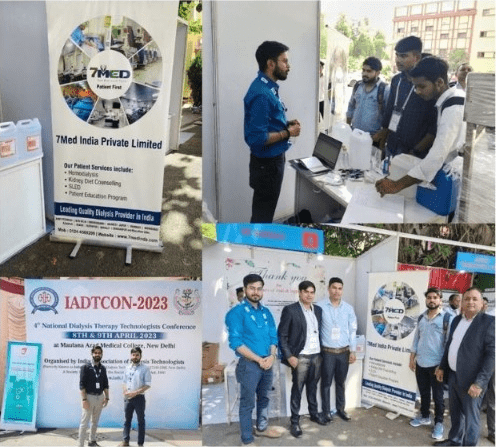
7Med attended the 4th Annual National Conference of Dialysis Technology 2023 in New Delhi. The event showcased the latest advancements in the field of dialysis and featured interactive sessions with renowned Nephrologists. But that’s not all! We also ran a successful recruitment drive and collected around lots of CVs from talented Dialysis Technicians. It was a fantastic experience for our team to learn, connect, and expand our network in the field of dialysis technology.

RECIPE OF THE WEEK: BAINGAN BHARTA

  • Roast the baingan over an open flame until the skin is charred and the flesh is soft.
  • Let it cool and then peel off the skin and discard it. Mash the baingan with a fork and set it aside.
  • Heat the oil in a pan over medium heat.
  • Add the cumin seeds and let them sizzle for a few seconds.
  • Add the onion, garlic, and ginger and saute until
  • the onion is translucent.
  • Add the tomato and cook until it is soft and mushy. Add the turmeric, coriander, and garam masala powder and mix well.
  • Add the mashed baingan and mix gently. add salt
  • to taste and let it simmer for 5-7 minutes.
  • Garnish with fresh cilantro and serve hot with steamed rice or chapati.

BOOK REVIEW: FINANCIAL
INTERPRETATION

Our team member, Vanishka Srivastava, recently read
the book “Warren Buffet and the Interpretation of
Financial Statements” and couldn’t stop raving about
it. In her review, she emphasized the importance of
analyzing percentages instead of numbers and
consistency being the key in choosing which company
to invest in. She even went as far as to say that every
member of our team should read it! So if you’re
interested in learning more about financial statements
and how to make better investment decisions, this
book is definitely worth checking out.

BUILDING A HEALTHIER WORLD

World Health Day is celebrated every year on April
7th to raise awareness about global health issues and
encourage individuals and organizations to take
action to improve health outcomes. This day
provides an opportunity to focus on specific health
concerns and highlight the importance of health
equity for all people around the world. The theme
for the World Health Day 2023 is “Health For All.”
The aim of the theme is to create an opportunity for
the world to look back at public health successes
that have helped improve the quality of life over the
past 70 years. The theme also calls on the world to
take required actions which can help tackle health
challenges today and tomorrow, the world health
body said.

Read More

7Med India has collaborated with AIIMS, Rishikesh

6th April 2021Team 7MedBlogNews & Updates
7Med India has collaborated with AIIMS, Rishikesh

In our efforts to further our mission of providing high quality dialysis treatments, 7Med India has collaborated with AIIMS, Rishikesh.

7Med was established in Dec 2013 under the visionary leadership of co-founders Mr. Vikas Verma, Mr. Mayank Sharma and Dr. Rakesh Thakur. We have been operational since 2014 & since then have provided almost 1,000,000 treatments to 5000+ patients across 20+ different locations in North India. And now our services are also available at AIIMS, Rishikesh.

We have firmly established ourselves as renal care pioneers. Our team of highly skilled & experienced medical professionals expertise in providing renal care services and they have been doing so with great success at all our clinics.

Every 7Med Kidney Care clinic is designed keeping the patient at its core. Apart from providing high quality dialysis treatments the 7Med team educates & trains the patients to become knowledgeable about dialysis and self care. This is how we empower patients to lead an effortlessly healthy life.

AIIMS, Rishikesh with their mission of establishing a center for excellence in healthcare is the quintessential partner for 7Med India as they uphold and abide by the same values and standards on the rostrum of which 7Med stands.

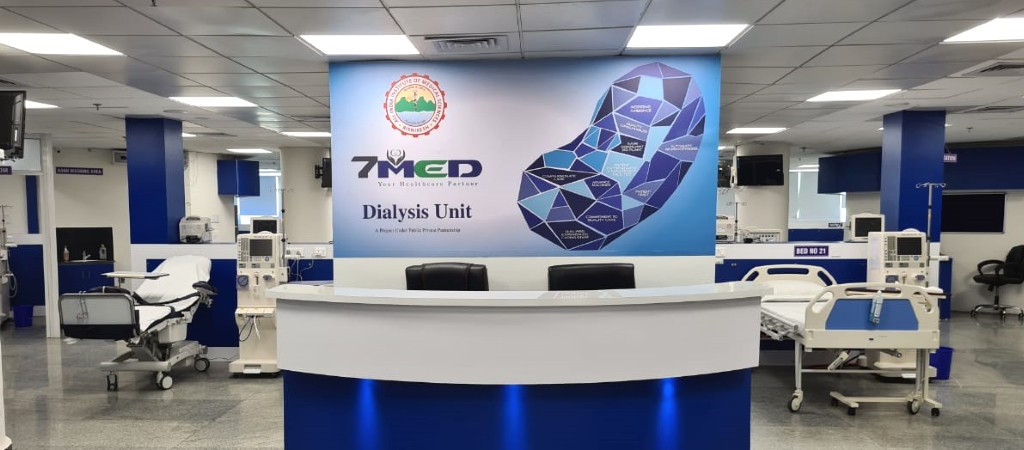
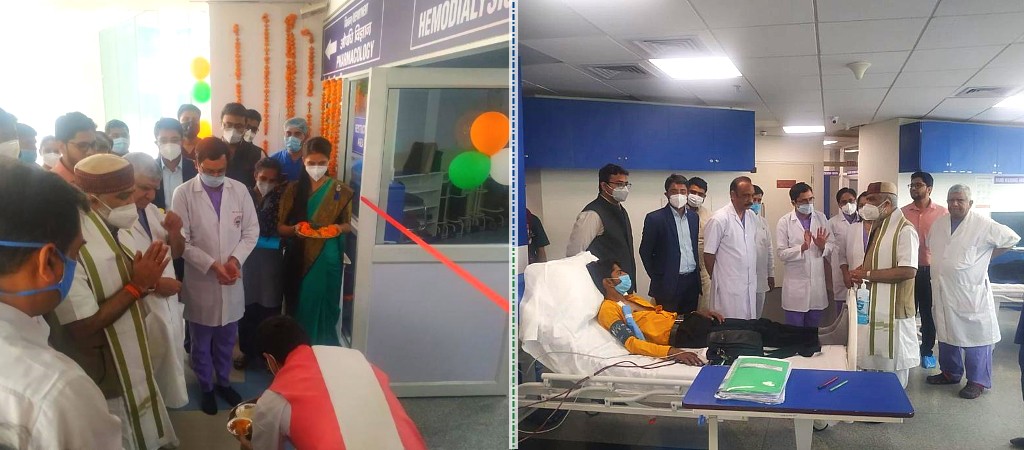
As a part of this collaboration, 7Med India has established a state of the art Dialysis Clinic at AIIMS, Rishikesh premises. The center was inaugurated by the honourable Minister of State for Health and Family Welfare, Shri. Ashwani Kumar Choubey on 1st of April, 2021. This center has 30 machines and is capable of carrying out 2500+ haemodialysis treatments per month. Apart from regular haemodialysis, we will also be carrying out advanced renal care treatments like SLED (Sustained Low Efficiency Dialysis) & OHDF (Online Haemodiafiltartion) at this center to ensure all renal care requirements of the region are fulfilled without fail.

With 7Med, patients have always got more than just a dialysis service provider. They get a caregiver and a partner that stands by their side, be it night or day, aiding and enabling them to live an unencumbered happy life.

And with this partnership with the august & illustrious institute of AIIMS (Rishikesh), we will keep delivering high quality services with unwavering dedication to the wonderful people of the magnificent state of Uttarakhand.

Read More

The Virus of the World

24th June 2020Shalin ShandilyaArticlesCOVID-19
The Virus of the World

The coronavirus disease, COVID-19, has the whole world’s attention. Since the outbreak began in China in December 2019 this virus has spread rapidly.

A group of viruses that look a bit like crowns is what coronavirus looks like. There are different types of coronaviruses, which only cause mild symptoms and illness. This type of Infectious diseases occur especially where animals and humans live close to one another.

Research is being carried out to find its source. Many of the viruses are known to originate in bats, which then transmit them via other animals to humans. SARS and Ebola are examples and are also originated in bats.

The symptoms of coronavirus initially produces the same symptoms as the cold, but these can develop into fever, breathing difficulties. Current estimations suggest that serious symptoms occur in around 17% of coronavirus patients and that the disease becomes fatal for around 2% of these people. But, this estimations might turn out to be lower, once more information becomes available.

The coronavirus is transmitted in the tiny droplets that are produced when people cough and sneeze. It is very important that you stay away at a distance of at least 1 meter from infected people.

The most important steps you can take against the coronavirus are very simple. Follow the general hygiene rules that apply to all common cold and flu viruses. It is important that one must follow these steps:

  • Wash your hands regularly with soap and water and/or use sanitizing hand gel.
  • Cough and sneeze into the inside of your elbow and use tissues.
  • Stay away from ill people and animals.
  • Only consume animal products that have been thoroughly heated.

Image: pikisuperstar – Freepik.com

Read More

Skipped a Heartbeat!!!

21st March 2020Hannah ArmandonStories from our Patrons
Skipped a Heartbeat!!!

Google: It means you have had heart palpitations, best described as a feeling that your heart is beating too hard or too fast.

Has this ever happened to you? Must have, I guess!!!
It happened with me too. Oh! I remember that day so vividly and no it didn`t happen when I saw prince charming.

I can tell you that most of my adventures happen on dialysis days. It was a Thursday, perfectly normal day, reached my 7Med Dialysis Clinic after chanting “5 mins more Mum”. Got hooked up to my machine, I prefer sleeping during my dialysis because I have weird sleeping patterns.
So one hour passed and I told my Mum that “I want to eat chips, please get me some from downstairs” and I turned to change my position and suddenly I got the feeling that I have had been running a marathon.

I became breathless, it was as if there is an engine revving up inside me, and so I somehow managed to call the nearby technician. When they checked my BP my heartbeat was 220 and rising. In minutes I had the entire team and the doctor standing by my bed. They immediately stopped my dialysis.

I do not panic in these kind of situations because of two people, my pastor (she told me god is with you never be afraid) and Mr. Binu (he said if I panic things will get out of hand, raise my BP and scare the other patients around me). Doctor in the clinic was there with me the whole time trying to comfort me as I became restless over time and my heart rate was fluctuating from 80 to 200. The medicine which was given to me was not working and by then my Mum had come back, with the wrong flavour of chips.

I was then transferred to the Emergency Room (ER) and then panic started. After reaching the ER everything started to look like the scene of Grey`s Anatomy (my favourite show).

Code Blue was declared, the entire cardiac team stood surrounding me. In my mind my whole life flashed in front of my eyes, I prayed and asked for forgiveness for all my sins. I looked over and saw my mother thinking maybe be it was the last time I was seeing her because they had the crash cart with them they had kept it ready. They were looking for a vein to put a cannula in (it’s been 8 years and I still don’t like injections and needles). Then it happened, they put an injection to slow my heart rate and I was told, “Look at that screen magic will happen”. I was like what the fish this is not the time to show magic. Crying like a little baby because of the cannula, I looked over and saw as the injection entered. I felt cold and the screen showing 200 heartbeat went to 0.

I screamed, “I am feeling heavy on my heart”. Doctor said it’s ok now. And then the screen showed 30…50…80…90…100.

Whoooo!!! The team clapped & cheered, told me and my mother everything is fine but I will be kept in observation for few hours.

I was advised to visit the Cardiac Doctor tomorrow and if anything like this happens at home, then immediately rush to the E.R.
Around 8 P.M I was discharged and it started to rain cats and dogs. I don’t enjoy Delhi rains as it creates traffic jams and huge rivers of dirty water. We found a cab, got stuck in traffic and reached home by 1 A.M. When I reached home I thanked god that I was back and had a real cool story to tell everyone.

Read More

7Med in talks for Series B Funding – Covered by VCCircle

10th January 2020VC CircleNews & Updates
7Med in talks for Series B Funding – Covered by VCCircle

VCCircle , India’s leading source of financial news, covered 7Med & its efforts to secure Series B funding.

Link to the original article published in VCCircle: https://tinyurl.com/v9d8mah

Read the complete article below.

“Dialysis clinic chain 7Med India Pvt. Ltd, which had received investment from a European company two years ago, is looking for fresh capital to grow in a market that is highly unregulated but has recorded some private equity action.

Vikas Verma, co-founder and director at 7Med, told VCCircle the company wants to raise Rs 90 crore ($13 million) in its Series B funding round. 

Talks are on with potential investors, he said, but didn’t disclose their identities and other aspects citing confidentiality issues.

Gurugram-based 7Med was founded in 2013 by Verma, Rakesh Thakur and Mayank Sharma. It had received funding from Russian dialysis firm Nefromed two years ago. Nefromed had invested through its India arm Dicopa.

The three founders were earlier associated with German dialysis services provider Fresenius Medical Care AG, which has a significant presence in India as well. Fresenius had acquired Tata Capital Healthcare Fund-backed dialysis services company Sparsh Nephrocare in 2016.

7Med, which ties up with hospitals to set up its clinics within their premises, had around five centres at the time of Nefromed’s investment. The number of centres has now risen to 21.

The company claims it conducts 7,500 treatments a month, and aims to have up to 100 centres in three years’ time. Verma said the company is looking to enter India’s eastern and northeastern regions next year and then establish its presence in the southern region.

Verma also said the company will launch its first standalone centre in Delhi by March as it seeks to build on the traction it has gained. A standalone store costs around Rs 15 crore, nearly ten times as much as a clinic within a hospital, but the company feels its own centres would help it build its brand.

The company has also won its first project to work with the government-backed All India Institute of Medical Sciences hospital in Delhi. This could help boost its presence in the country.

The government in its Budget for 2016-17 had noted that India gets about 2,20,000 new patients of end-stage renal disease every year and that the annual expense burden on each patient is more than Rs 3,00,000. Hence, the government had proposed to start a National Dialysis Services Programme to provide renal-care services in district hospitals.”

By: Joseph Rai, VCCircle

Read More

डायलिसिस तकनीशियन होना आसान नही

4th September 2019Arif KhanTeam Talent Zone
डायलिसिस तकनीशियन होना आसान नही

एक मामूली सा डायलिसिस तकनीशियन हूँ, बेशक कोई भगवान नही

डायलिसिस तकनीशियन होना मगर इतना भी आसान नही

इस दर्जे की खातिर मैने अपनी हर खुशी को खोया है
मैं वो हूँ जो किसी भी मरीज की हालत खराब होने पर रोया है

सुकुन की जिंदगी को कुर्बान करता हैं डायलिसिस तकनीशियन
कभी कुर्सी तो कभी इमरजेंसी टेबल पे सोया है

जाने कब होली बीती, जाने कब दिवाली गई
जाने कितने रक्षाबंधन,मेरी कलाई खाली गई

परीक्षाओं की लड़ी ने साथ नही छोड़ा अब तक
मेरे हज़ारों दिन खा गई,उतनी ही रातें काली गई

फिर भी तुम्हें हर वक्त जो खुश दिखे परेशान नही
डायलिसिस तकनीशियन होना इतना भी आसान नहीं।

मैनें क्रिकेट का बैट छोड़ा, टीवी का रिमोट छोड़ा
सफेद एप्रन की खातिर मैने जैकेट-कोट छोड़ा

मेरा कोई संडे नही, छुट्टी की गुज़ारिश नही
सर्दी का कोहरा या पहली वाली बारिश नही

मेरा परिवार मुझसे बात करने को तरसता है
लेकिन कभी पूरी होती उनकी ख्वाहिश नही

अपने ऊपर गर्व है मुझे,लेकिन कोई गुमान नही डायलिसिस तकनीशियन होना इतना भी आसान नही

जाने कितने लोग हमने ‘नींद’ से जगा दिए
जाने कितने अंधेरे हमने दुनिया से भगा दिए

तुम भी तो मेरी इस हालत से अनजान नही
डायलिसिस तकनीशियन का होना इतना भी आसान नही।

Read More

Life of a Dialysis Patient

28th May 2019Ketakee ShrivastavaArticlesBe The ChangeDialysis Patient
Life of a Dialysis Patient

Its truly said that pursuing MBA exposes you to the harsh realities of the world. So did mine! During the three and a half month internship period at 7 Med India Private Limited, I learnt a great deal and this was not confined just to softwares and financial statements.

7 Med India Private Limited operates in healthcare sector by rendering quality dialysis services to people suffering from Chronic Kidney Diseases. The kidneys of these patients become incapable of performing the basic function of purification of blood by waste excretion along with maintenance of body fluids. Because of this, such patients have to seek the purification of their blood outside their body with the help of artificial kidneys.

7Med Team at their Aryan Hospital Dialysis Clinic

7Med Team at their Aryan Hospital Dialysis Clinic

While the world is changing at an ever escalating pace, a dialysis patient feels hapless as if restrained by the shackles of their treatment. Kidney related diseases take a toll on not only the physical body of it’s victims but snatches away their peace of mind making them restless and bleak from inside.

Bound by their very own bodies, they require a great deal of physical support and the trivial everyday tasks are often looked upon by them as prodigious mountains that they have to climb. Their lives suddenly become extremely dependent on man-made machines which pretty often make them feel a deep sense of loss of control as if they are no longer the captain of their life’s boat.

Depression, anxiety and ambiguous feelings fill their heart and mind making them weak in every aspect. Even though dialysis has successfully brought down the mortality rate yet there are still many who consider it as the sole culprit that took their happiness away. Their life is curbed by the disease in numerous ways and they often find themselves as restricted and controlled like marionette.

Ergo, one should never lose even a single opportunity of lifting the spirits of a dialysis patient for if every able man makes a vow to help just a single patient in his entire journey of life then an unimaginable world wide change could be brought in these people’s lives!

Follow Ketakee Shrivastava on WordPress.

Read More

  • 1
  • 2
  • Next

Latest Posts

  • Why Kidney Disease is Called a “Silent Killer” in India
  • How to Choose the Right Dialysis Centre in Delhi NCR (And Avoid Costly Mistakes)
  • 7MED Welcomes Strategic Investment from PVP Ventures to Accelerate Healthcare Innovation
  • How to keep yourself and your kidneys healthy?
  • Take morning walks to stay healthy

Knowledge Base

1. Anaemia Management
  • Fast facts on Anaemia
  • Anaemia Symptoms
  • Anaemia Investigation
  • What is Erythropoietin?
  • Anaemia Monotoring
2. Dialysis Adequacy
  • Dialysis Dose & Adequacy
  • Urea Reduction Ratio
  • KT/V
  • URR & KT/V
  • Improving KT/V
3. Vascular Access Management
  • Vascular Access & its Types
  • Taking care of your access
  • Catheters
  • Taking care of your Catheter
4. Diet & Fluid Control Tips for Dialysis Patients
  • Make your low salt food Tasty!
  • Break the Salt Addiction
  • Avoid Artificial Salt Substitutes, Go Natural!
  • How to manage your daily fluid quota?
  • The Art of Savouring for Fluid Control
  • Tips to control thirst & fluid intake
  • 5 Potassium Rich Fruits That CKD Patients Should AVOID
  • 5 Potassium Rich Vegetables That CKD Patients Should AVOID
5. Kidney Friendly Recipe
  • Chana Dal Soup
  • Mixed Veg Curry
  • Baingan Bharta
  • Masala Bhindi
  • Rava Appam
  • Oats Chila
  • Sabudana Khichdi
  • Berry Tofu Smoothie
  • Vegetable Cutlet
  • Mango Rice
  • Omelet
6. Kidney Friendly Food
  • Blueberries
  • Grapes
  • Kidney Beans
  • Green Vegetables
  • Lemon
  • Strawberries
7. Health and Wellbeing
  • How to boost your immunity?
  • Tips to increase your immunity
  • Take morning walks to stay healthy
  • How to keep yourself and your kidneys healthy?

7Med India

Kidney Care Center

+91 7718-771-888

info@7medindia.com

www.7medindia.com

M3M Urbana Premium, Floor 12A, Sector 67, Golf Course Ext. Road, Gurugram, Haryana - 122101, India

Quick Links

  • About Us
  • Advisory Panel
  • Our Clinics
  • Our Services
  • Contact Us
  • Careers

Policy

  • Terms & Conditions
  • Privacy Policy
  • Refunds & Cancellation
Copyright ©2016 all rights reserved