
How to Choose the Right Dialysis Centre in Delhi NCR (And Avoid Costly Mistakes)
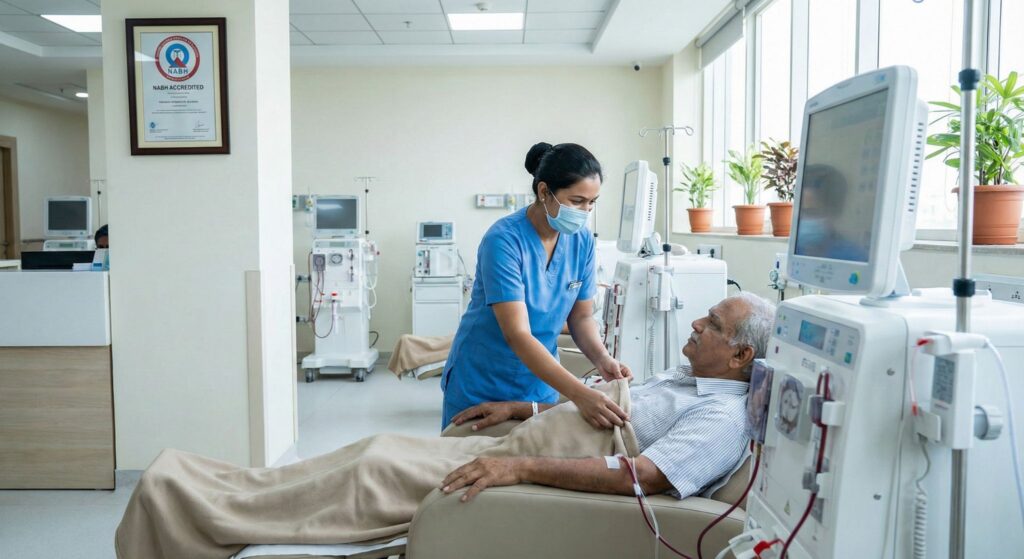
Last month, a 52-year-old patient walked into the Dialysis Centre at Epitome Kidney Urology Institute with a severe infection. He’d been on dialysis for eight months at a dialysis centre in Delhi. Upon examination, our medical team found that his dialysis access site was inflamed, he had recurring fevers, and his recent blood reports showed alarming signs of infection.
“Hame laga dialysis to dialysis hi hai kisi bhi clinic mein karao, Pani hi to nikalwana hota hai,” he told our Nephrologist, his voice tired and defeated. “Hamare ghar ke sabse paas jo hospital tha wahi dialysis kara rahe the.”
(I thought dialysis is just a simple procedure to get extra fluid/water removed. There is a dialysis facility in a hospital near our home, so we were getting dialysis there itself.)
That decision almost cost him his life.
After nearly one and a half decades of running dialysis clinics across North India through 7Med India and now providing full-fledged kidney care, including Kidney Transplant at Epitome Hospital, I’ve seen this story play out too many times. Patients assume dialysis is just a simple process of removing fluid/urine, which is not the whole truth. They assume that every center follows the same protocols, uses the same quality standards, and delivers the same outcomes.
They’re dangerously wrong.
The dialysis center you choose isn’t just about convenience or cost. It’s literally a matter of life and death. Patients can face numerous issues like infections and toxicity in the bloodstream due to poor water quality, sero-conversion and other life-threatening infections due to poor sterility and hand hygiene. Lack of attentive staff and inadequate monitoring can lead to missed warning signs which, at times, can be fatal.
And the quality gap between a dialysis clinic near your home and the best in the city can be wider than ever.
The Hidden Dangers of the Wrong Choice
After kidney failure, dialysis becomes your lifeline—filtering waste and excess fluid from your blood two to three times a week, every week, potentially for the rest of your life. But what most patients don’t realize is that the quality of that filtration depends mostly on factors they can’t see.
Let’s See What You Must Look For (Before It’s Too Late)
Choosing a dialysis center isn’t like picking a restaurant. You can’t rely just on Google reviews alone. Below are the non-negotiables I recommend every patient should look for while choosing a dialysis clinic:
1. Water Testing Reports
Ask for recent water testing reports. Any quality-focused centre should test water quality regularly and comply with AAMI (American Standard For Dialysis Water) or EU (European Standard For Dialysis Water) standards, or our own Indian standards recommended by ISN (Indian Society of Nephrology). If the dialysis staff hesitates to show you these reports or avoids sharing them, consider it a big red flag.
The water quality defines everything else. Don’t compromise on it.
2. Dialyzer Reuse Protocols
Find out if the center reuses dialyzers and, if so, what protocols they follow. Specifically ask:
- Do they have an automated dialyzer reprocessing machine?
- How many times is each dialyzer typically reused?
- How do they determine when a dialyzer should no longer be used?
Without automated reprocessing, there’s no reliable quality control. Manual cleaning and testing leave too much room for human error.
3. Staffing and Staff Training
The dialysis technician-to-patient ratio matters tremendously. International standards recommend one trained dialysis nurse for every four to five patients. Ask about staff credentials—are they trained dialysis technicians or general nursing staff?
A well-trained, adequately staffed center can identify and address complications before they become emergencies.
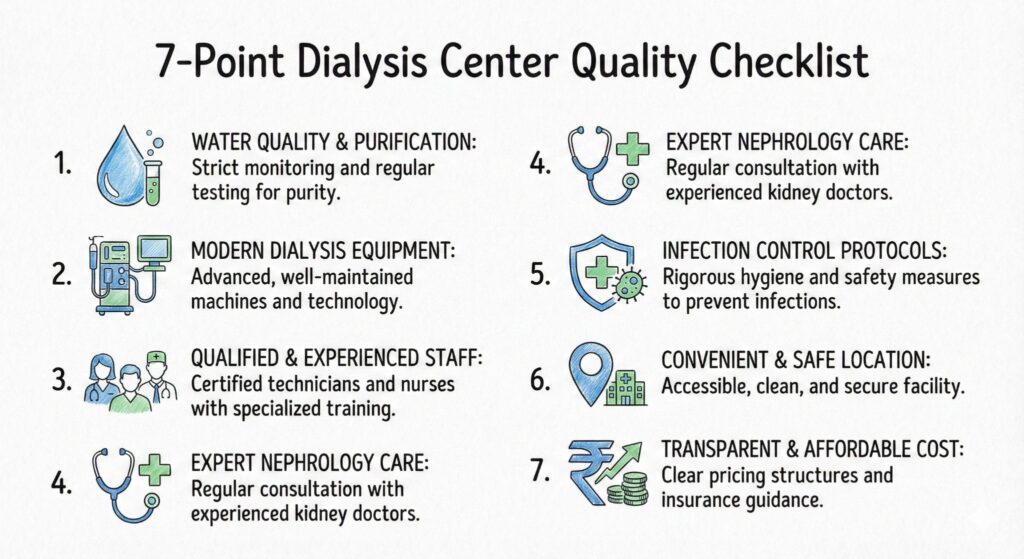
4. Nephrologist Presence and Accessibility
In India, it’s practically not possible to have a Nephrologist at every dialysis center, thus if the dialysis clinic is covered by a doctor and supervised by a Nephrologist, that should be fine. The target for a patient should be to do regular consultations with the treating Nephrologist, and the dialysis clinic should also be regularly visited by a Nephrologist to do an overall review of clinical protocols.
On this front, single-specialty dialysis chains like 7Med and hospitals focused on kidney care like Epitome Kidney Urology Institute do much better comparatively.
At our 7Med clinics and at Epitome, we ensure nephrologist oversight because we’ve learned—often the hard way—that minutes matter in dialysis emergencies.
5. Quality & Infection Control Protocols
Ask about their infection control measures. How often are machines disinfected (after each dialysis or once a day)? What protocols do they follow for vascular access care? Do they segregate patients with infections? What’s their track record with dialysis-related infections?
These aren’t invasive questions—they’re your right as a patient whose life depends on these answers.
A good indicator of quality in today’s environment are accreditations. Accreditations from NABH, QCI, etc., guarantee that the dialysis clinic follows industry-standard quality protocols which are audited regularly by a third party independently.
6. Location and Consistency
While quality trumps convenience, you also need to think practically. You’ll be coming to this center three times a week, potentially for years. Is it accessible? Can you maintain that schedule during the monsoons, Delhi’s infamous traffic jams, or when your own health fluctuates?
More importantly, can the center accommodate you consistently? Nothing disrupts care more than constantly shifting between centers because your “home” facility can’t guarantee you a slot.
7. Insurance Panels
Dialysis is a costly affair. Dialysis patients end up paying close to 20-30 thousand rupees just for dialysis. Add in the medication costs, diagnostic tests, and doctor consultation costs, which can take this amount anywhere up to 40 to 50 thousand rupees. Thus, identifying a dialysis clinic which is empanelled with the insurance company you are insured with will help you significantly.
In case you don’t find a hospital or dialysis clinic empanelled with your insurer, you don’t need to get discouraged or compromise on your choice of dialysis clinic. Talk to the dialysis provider, and they will help you understand and navigate the reimbursement process.
People meeting certain criteria may be covered under PMJAY (Pradhan Mantri Jan Arogya Yojana) or Ayushman Bharat Yojana—check your eligibility with the hospital.
The Delhi NCR Dialysis Landscape
Delhi NCR has seen explosive growth in dialysis centers over the past decade. Government initiatives like Ayushman Bharat and the National Dialysis Program have made treatment more accessible—which is wonderful. But accessibility means nothing without quality.
The challenge for patients is that not all centers are created on quality parameters. Some are run by experienced nephrologists with decades of kidney care expertise. Others are commercial ventures where dialysis is just another revenue stream, managed by administrators who’ve never actually cared for a kidney failure patient.
I strongly recommend patients to stay away from dialysis clinics which are operated by a dialysis technician and not a proper hospital or organizations dedicated to providing dialysis like 7Med India.
At 7Med India, we’ve built our network of 20 dialysis clinics across 14 cities with one non-negotiable principle: PATIENT FIRST. Not just that, we have taken our commitment to kidney patients to the next level by establishing institutes like Epitome Kidney Urology Institute which provide holistic kidney care including kidney transplants, not just dialysis. Not to forget that our clinical programs are governed by preeminent Nephrologists like Dr. Vijay Kher, Chairman of Epitome Kidney Urology Institute, and Dr. Ajay Kher, Group Medical Director.
We don’t just provide dialysis—we help our patients understand their condition, participate in their care decisions, and recognize warning signs that need attention.
This isn’t a sales pitch. It’s a reflection of what I’ve learned after spending years watching patients suffer from fragmented, poor-quality care.
Listen to our detailed podcast episode: “Things To Consider While Choosing A Dialysis Clinic” at Kidney Support Network Podcast.
This episode breaks down each critical factor in Hindi, in simple language that patients and families can understand and act on. Because in kidney care, knowledge isn’t just power—it’s survival.
Don’t let convenience or cost alone drive this decision. Don’t assume all centers are the same. And don’t wait until complications force you to learn these lessons the hard way.
Your kidneys have failed. But your dialysis center can still become part of your winning team.
Need Help Choosing the Right Dialysis Center?
Don’t navigate this decision alone. Contact us for expert guidance and consultation.
7Med India – Dialysis Centers Across North India +91 7718-771-888
 info@7medindia.com
 www.7medindia.com/our-clinics
About the Author: Mayank Sharma is CEO and Co-Founder of Epitome Kidney Urology Institute and Co-Founder & Director of 7Med India. With over 18 years in healthcare, he’s dedicated to patient education and improving dialysis care standards across India.
Related Reading:
- Understanding Dialysis Adequacy – KT/V Explained
- Vascular Access Care Guide
- Diet Tips for Dialysis Patients
Source: https://www.kidneysupportnetwork.com/blog/how-to-choose-the-right-dialysis-centre-in-delhi-ncr-and-avoid-costly-mistakes/